
Agentic commerce for small stores: what's live, what's announced, what to do
Yevhen Kurapov, co-founder · Updated Oct 13, 2026
Agentic commerce means AI assistants finding and buying products for shoppers. In October 2026, ChatGPT shopping is live for US users, who finish purchases on the store's own checkout; OpenAI shifted from Instant Checkout to discovery in March. UCP (Google, Shopify) and ACP (OpenAI, Stripe) are the standards underneath. Your job: accurate product data, clear policies, honest stock.
For a small store, agentic commerce today mostly means one thing: AI assistants such as ChatGPT can show your products to shoppers who ask them for advice. Buying inside the chat exists on some channels, but in March 2026 OpenAI moved its focus from its own Instant Checkout to product discovery. If you're on Shopify and sell to the US, your products may already be showing in ChatGPT without you doing anything. What you control is the product data an AI reads, the policies it quotes and the stock figures it relies on.
Five terms in plain words
| Term | What it means | Who is behind it |
|---|---|---|
| Agentic commerce | An AI assistant doing part of the shopping for someone: searching, comparing, building a cart, sometimes paying | The industry's umbrella term |
| UCP (Universal Commerce Protocol) | An open standard for how AI agents talk to stores: catalog, cart, checkout, orders, account linking | Announced by Google in January 2026 with Shopify, Etsy, Wayfair, Target and Walmart |
| ACP (Agentic Commerce Protocol) | An open standard for how ChatGPT passes orders to merchants and, since March 2026, receives their product data | OpenAI and Stripe, September 2025 |
| Instant Checkout | Buying inside ChatGPT without leaving the chat | OpenAI; launched September 2025, merchants moved to their own checkout in March 2026 |
| Shopify Catalog and agentic storefronts | Shopify's feed of your products to AI channels, and its setting for which channels you sell in | Shopify; agentic storefronts announced December 2025 |
The protocols are plumbing. They matter to platforms like Shopify, Stripe, Google and OpenAI. As a store owner, you meet them through settings and product data, not code. If you want the technical layer, our guide to Shopify MCP for merchants walks through the servers Shopify runs for each store.
What's live today vs announced
As of October 13, 2026, from the companies' own pages:
Live
- Shopping in ChatGPT, US only. Since March 24, 2026, ChatGPT shows richer product results to US users on free, Go, Plus and Pro. Shopify and Etsy catalogs are already integrated; other merchants apply through OpenAI's merchant page and join a waitlist. By default, shoppers buy on the merchant's own site, with no OpenAI fee on those purchases.
- Shopify stores in ChatGPT. Shopify says millions of merchants can sell to ChatGPT users. Your store qualifies if it sells to US customers and your products are eligible for Shopify Catalog. Buyers check out on your store in ChatGPT's in-app browser.
- Microsoft Copilot direct checkout. Eligible Shopify stores selling to the US can let US shoppers pay inside Copilot through a Shopify-powered checkout. Shopify said thousands of merchants were selling there in March.
Rolling out
- Google AI Mode and Gemini. Google launched UCP checkout in January 2026. Shopify's help center says it is rolling out to eligible stores based in and selling to the United States, through Google Merchant Center. Outside Shopify, Google's merchant page asks businesses to join a waitlist.
- Meta. Shopify's help center now documents a Shopify-powered checkout on Meta surfaces for stores selling to the US, Canada or Mexico.
Announced, not generally available
- Multi-merchant carts. Shopify's Universal Cart API, one cart holding items from several stores, has an early access waitlist.
- A self-serve ChatGPT merchant platform. OpenAI says one is planned for later this year.
Changed
- ChatGPT Instant Checkout. It launched on September 29, 2025, for US users buying single items from US Etsy sellers, with Shopify merchants "coming soon". On March 24, 2026, OpenAI said the first version wasn't as flexible as it wanted and that merchants can use their own checkout while it focuses on product discovery. Shopify's ChatGPT channel now sends buyers to your checkout.
What changes for a 10-person store
Less than you might expect, and most of it is already switched on.
If you're on Shopify and sell to the US, your products may already appear in ChatGPT. Agentic storefronts are active by default for eligible stores, and you can see and change them under Sales channels, then Agentic, in your Shopify admin. Orders from AI channels arrive in your admin like any other, marked with the channel that sent them, and you stay the merchant of record. Shopify says there are no fees for ChatGPT beyond payment processing.
If you sell only outside the US, ChatGPT's shopping results don't reach your customers yet, and Google's checkout is limited to US stores. Your products can still turn up in ordinary AI answers, from your web pages. Nothing here needs a project today.
If you're not on Shopify or Etsy, joining means applying: OpenAI's merchant form for ChatGPT, Google Merchant Center and its UCP waitlist for Google. Stripe supports sellers on both UCP and ACP, so if you take payments through Stripe, ask your platform what it plans to support.
What doesn't change: customers still have questions after they land on your site, still want to know where their order is, and still message you on WhatsApp and Instagram. An AI channel sends you a shopper; it doesn't answer their next question about sizing or delivery.
Five things to do this quarter
- Clean your product data. Shopify Catalog sends your titles and descriptions to AI channels by default, and needs a title, an image, a price above zero and a published product URL for each product. Put the facts shoppers ask about, such as size, material, fit and compatibility, in the description, not only in a photo.
- Write your policies as text. Fill in terms of service, privacy, and returns and refunds under Settings, then Policies, and keep shipping times and costs on a page. AI agents quote what they can read, and Copilot's direct checkout requires those policies.
- Keep stock and prices accurate. AI channels read your live catalog. A product shown as in stock that isn't costs you the sale and a refund conversation. Unpublish or set to Unlisted what you can't fulfil; Unlisted also hides it from search engines.
- Put an assistant on your own site that answers from your catalog. The shoppers AI channels send you, and everyone else, arrive with questions. See the next section.
- Measure AI-referred orders. Once a month, look at your orders by channel in your admin. If ChatGPT or Copilot sends you nothing after a quarter, you haven't lost anything; if it sends you orders, you'll know which products it likes.
Where an on-site assistant fits
AI channels and your own assistant work at different moments. ChatGPT helps someone choose between stores. Your assistant helps someone who already chose yours: is this in stock in a medium, does it ship to Canada, where is my parcel.
ChatPal is one way to cover that moment on a Shopify store, and on the messaging apps your customers already use:
- it answers from a copy of your Shopify catalog that stays in sync within minutes, and re-checks stock and price before answering;
- it shows each customer the price for their own country, in their currency, and replies in their language;
- it answers on your website, WhatsApp, Instagram, Messenger and Telegram, with product cards;
- it tells a signed-in customer where their order is, and passes cancel or delivery-change requests to you;
- in your storefront chat, it adds products to the cart and shows what's in it.
It starts free for 100 replies a month, and $20 a month buys 500. Shopify Inbox's free AI agent is the other obvious choice if your customers only write in your store's chat; our Shopify Inbox alternatives comparison covers when it's enough.
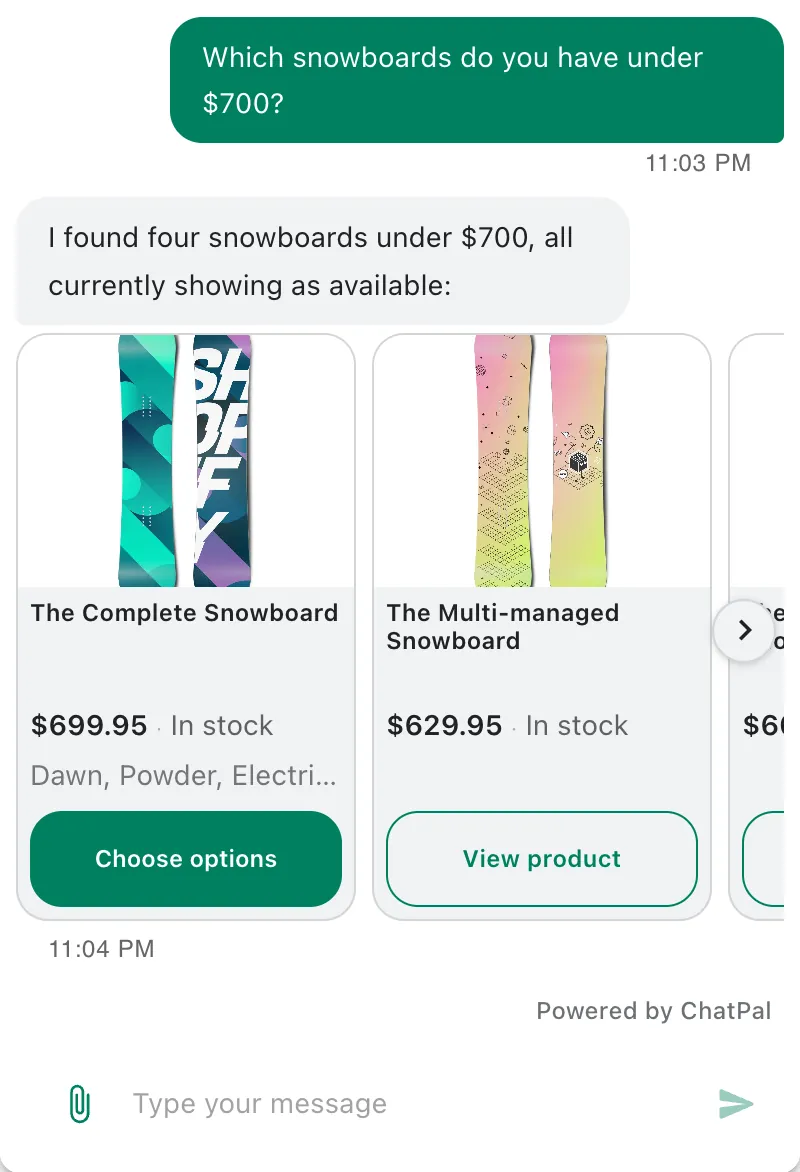
To set one up, follow the Shopify AI shopping assistant guide. The details of what ChatPal does with a store are on the e-commerce page.