
Product finder quiz or AI shopping assistant: when each one wins, and what they cost
Yevhen Kurapov, co-founder · Updated Oct 19, 2026
A product finder quiz wins when a few attributes every shopper can answer decide the choice and you want answers in your email tool. An AI assistant wins on vague requests and follow-ups. RevenueHunt, VQB and Octane AI's paid plans start at $30 to $50 a month for 400 to 500 quizzes; a chat usually costs more per shopper.
A product finder quiz wins when your range splits by a few attributes every shopper can answer, such as skin type or roast, the catalog is small enough to map by hand, and you want the answers in your email tool. An AI shopping assistant wins when shoppers describe situations your answer options don't cover, or come back with follow-ups: "is it in 9.5?", "which of these two is lighter?". Per shopper, a quiz usually costs less, and you can run both. We make ChatPal, an AI assistant. The quiz prices below come from each vendor's own pages, and we say where a quiz is the better buy.
The difference at a glance
| Product finder quiz | AI shopping assistant | |
|---|---|---|
| How the shopper answers | Taps through a few questions you wrote | Writes in their own words, and gets asked only what they left out |
| A request you didn't plan for | Squeezed into the nearest option | Searched as written |
| After the result | The shopper reads product pages, or writes to support | Asks the same chat: one size's stock, a comparison, delivery |
| When the range changes | Someone re-maps answers to products | Searches the current catalog |
| Same result every time | Yes, you chose it for each path | No, it searches, so wording changes results |
| Answers in your email tool | Yes, on apps connected to Klaviyo or similar | No |
| Where it runs | A page or popup on your site | Your site chat and messaging apps |
| You pay per | Completed quiz, response or session | Reply |
One shopper, through a quiz and through a chat
Take a made-up running shop with about 40 road and trail shoes. A shopper wants trail shoes for rocky ground, often in the rain, under $150, in size 9.5. There's one complication: she runs about a mile of road to reach the trail.
Through the quiz
| Question | Options | She picks |
|---|---|---|
| Where do you run most? | Road, Trail, Treadmill | Trail. There's no option for both. |
| What's the ground like? | Smooth paths, Rocky or technical, Mud | Rocky or technical |
| Do you run in the wet? | Rarely, Often | Often |
| How far do you run each week? | Under 10 miles, 10 to 25, Over 25 | 10 to 25 |
| What's your budget? | Under $100, $100 to $150, Over $150 | $100 to $150 |
Five taps and about thirty seconds later she gets three shoes, the ones you mapped to that path: the Ridgeline WP at $148, the Scree Runner at $139 and the Talus Trail at $135. If the results page asks for her email and the quiz app is connected to Klaviyo or a similar tool, her answers go there with it, so next month's trail campaign can reach her.
Then she opens three product pages to check 9.5. The Talus is sold out in her size. Whether a quiz hides a sold-out size depends on the app and how you set it up. Her road question doesn't fit any option, so it goes to your support inbox or nowhere.
Through the chat
Here is how ChatPal handles the same need on that store. We wrote it from the rules ChatPal's assistant follows; it's an example, not a recorded chat.
Shopper: I need new running shoes.
Assistant: Happy to help. Where do you do most of your running?
Shopper: Rocky trails, often in the rain, but there's about a mile of road to get there. Under $150 please.
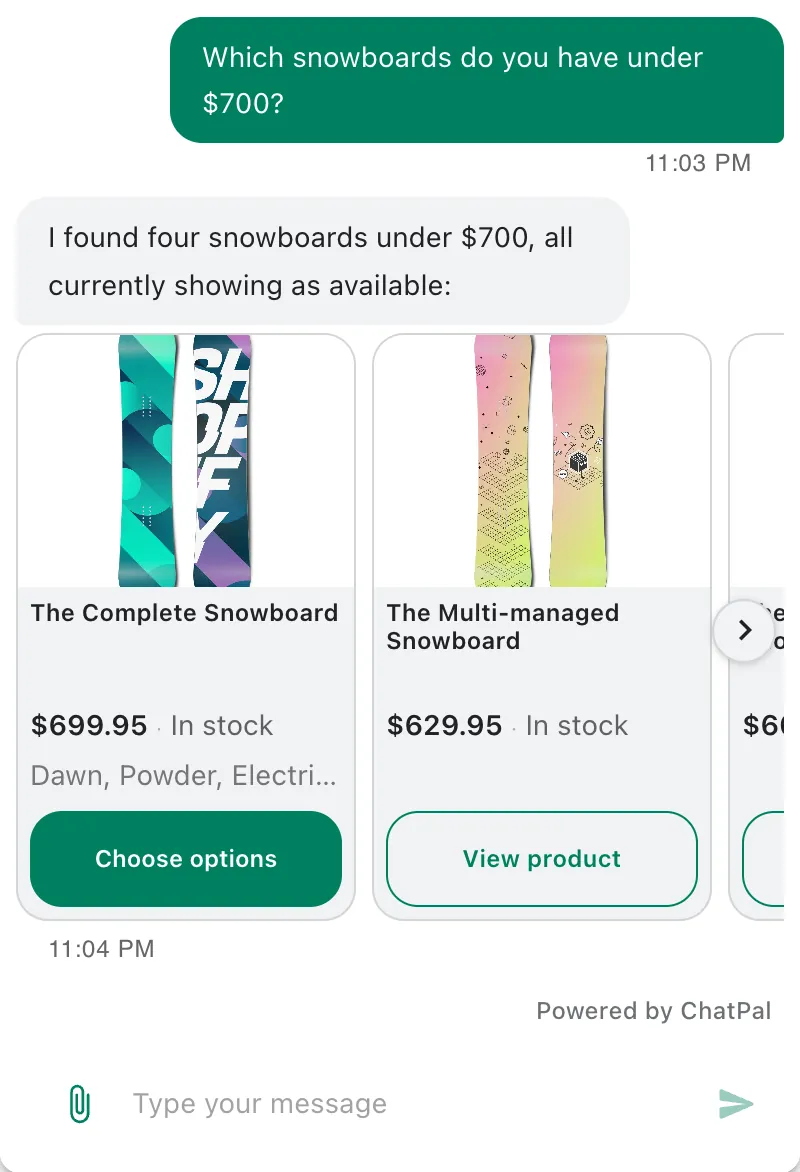
Assistant: Here are two trail shoes under $150, both in stock: the Ridgeline WP at $148, listed as waterproof with 5 mm lugs, and the Talus Trail at $135, listed as water-resistant with a rock plate. Want me to compare them?
[Card: Ridgeline WP, $148, in stock]
[Card: Talus Trail, $135, in stock]
Shopper: Do you have both in 9.5?
Assistant: The Talus Trail is sold out in 9.5 right now; it's in stock in 9 and 10. The Ridgeline WP is in stock in 9.5.
Shopper: Will the Ridgeline be OK on the road part?
Assistant: Its listing describes it as a trail shoe with 5 mm lugs and doesn't say how it does on pavement. If you leave your email, our team can check and get back to you.
What the comparison shows
The quiz was faster to fill in, its result was exactly what you chose for that path, and it left you her answers in your email tool, ready for a segment.
The chat asked one question, then took the wet ground, the budget and the road detail in her own words, and checked stock for her size, not for the shoe as a whole. Where the listing didn't cover the road part, it said so and asked for her email instead of guessing. It showed two shoes, not three, because only two listings mention protection from water. A shopper who words the same need differently might see a different pair.
Behind the chat: a connected Shopify store, listings that state waterproofing, lug depth and the sole plate, and lead capture set to collect only Email. ChatPal keeps its copy of the catalog in sync, usually within minutes, so the sold-out 9.5 showed without anyone re-mapping a quiz.
When a quiz is the better choice
- A few attributes decide everything. Coffee by roast and brew method, skincare by skin type and concern, pet food by species, age and size. If you can draw the decision as a short tree, a quiz walks every shopper down it the same way.
- Shoppers don't know the words. Someone new to trail running won't type "rock plate" or "lug depth". Picking "Rocky or technical" from three options is easier than describing the ground.
- You want the answers for marketing. Octane AI syncs with Klaviyo on every plan, and RevenueHunt connects to Klaviyo from its $39 Basic plan, so "dry skin, budget under $40" can become a segment you email. That is the main thing a quiz does that a chat doesn't.
- You want full control of the result. Every path ends on products you picked, in the order you picked, including a bundle or a product you want to push.
- Volume is high and margins are thin. At the published prices below, a quiz costs less per shopper.
When an assistant is the better choice
- Requests don't fit your options. "Trail shoes, but a mile of road first", "a gift for my dad who just took up birdwatching", a photo and "something like this". A quiz squeezes these into its nearest answer; an assistant searches for what was written, and says when nothing meets every requirement.
- The questions come after the result. One size's stock, a comparison of two products, delivery and returns. A quiz ends on a results page; in a chat the next question goes to the same place.
- The range is large or changes often. Every new product needs a place in the quiz's map. A connected assistant searches the current catalog, and ChatPal checks price and stock again before it answers.
- Shoppers write in messaging apps. A quiz is a web page you can link to. ChatPal answers from the same catalog in Instagram DMs, Facebook Messenger, WhatsApp and Telegram, with product cards.
- Shoppers land on a product page first. On a product page of a connected store, the chat knows which product it is, so "does this come in wide?" needs no product name.
What the assistant won't give you: answers synced to your email tool, a result you fix in advance for each path, recommendations based on past orders, or a filter across the whole catalog by one attribute, such as everything in size 10. Our guide to AI product recommendations on Shopify covers how it searches and what it refuses to suggest.
What each costs
Quiz apps and chat assistants charge for different things. Octane AI and RevenueHunt count completed quizzes, VQB counts quiz sessions, and ChatPal counts the replies its assistant writes. A product finder conversation takes several replies: four in the example above.
Prices from each vendor's page, checked on 19 October 2026, billed monthly in USD:
| Tool | Entry price | What it includes | Over the limit |
|---|---|---|---|
| RevenueHunt | Free, then $39 a month | 100 responses free; 500 on Basic, 1,000 on Pro at $99 | Quizzes lock at 125% of the limit, counted over the last 30 days; Premium is $199 for 2,500 |
| VQB: AI Product Quiz Builder | Free, then $30 a month | 50 sessions and one 5-question quiz free; 500 sessions and 100 AI agent sessions on Convert | $0.08 per extra quiz session |
| Octane AI | $50 a month, 14-day trial | 400 completed quizzes, up to two quizzes; Plus is $200 for 2,200 | $0.10 per extra completion |
| ChatPal | Free, then $20 a month | 100 replies free; 500 on Starter, 1,500 on Standard at $50, 4,000 on Pro at $120 | Alert at 80%; replies pause at 100% until you move up a plan or the month resets |
Octane AI's AI features use extra credits (in its own example, a completion with AI recommendations takes about 1.3 credits), and yearly billing takes about 15% off Octane and 20% off RevenueHunt.
What a month costs at three volumes. We assume each shopper finishes one quiz or has one conversation, and that a conversation takes four replies, as in the example. VQB counts sessions, so if a session starts when a shopper opens the quiz, you may need more of them than finished quizzes.
| Shoppers a month | RevenueHunt | VQB | Octane AI (no AI features) | ChatPal (4 replies each) |
|---|---|---|---|---|
| 100 | $0 (Free) | $30 (Convert) | $50 (Basic) | $20 (Starter, 400 of 500 replies) |
| 300 | $39 (Basic) | $30 (Convert) | $50 (Basic) | $50 (Standard, 1,200 of 1,500) |
| 1,000 | $99 (Pro) | $50 (Convert Pro) | $110 (Basic plus 600 extra) | $120 (Pro, 4,000 of 4,000) |
At 1,000 shoppers the chat is the most expensive line, and product finding alone uses all of Pro. The same allowance also covers delivery, returns and size questions on every channel, and your own tests, so leave room. What the extra buys is the follow-ups a quiz sends to your inbox.
Count your own time too. A quiz needs its answer map updated whenever products come and go. An assistant needs listings that state facts ("waterproof membrane, 5 mm lugs", not "built for adventure") and a weekly read of its chats.
How to run both
The two cover different moments, so you can keep the quiz for "where do I start?" and let the chat take everything after it. With ChatPal on a Shopify store:
- Connect the store. The Shopify setup guide covers connecting it and turning on the chat widget in your theme. Product questions then work in the chat on every page, quiz results included.
- Put the quiz one tap away in the chat. Under Chat Widget, open Advanced settings, then Launcher configuration, and switch on Show a channel menu when visitors click the launcher. Keep the “Chat with us” option, which uses Open the chat, then click Add channel for one that uses Open a link to your quiz page, labelled something like "Take the shoe quiz".
- Give the chat a guided start. Under Configuration, in the Greeting card, add a Quick replies button such as "Help me choose". In the Instructions card, write your quiz's first two questions as a rule: "When someone asks for help choosing shoes and hasn't said where they run, ask that first. Then ask their budget. Show at most three products." The assistant asks one question at a time and skips any the shopper has already answered.
- Collect what you'd otherwise lose. On the Handoff & leads tab, in the Lead capture card, check that Enable lead capture is on (new assistants have it on). Under Contact details to collect, tick Email, and untick Name and Phone if an email is all you need. Under Custom fields, click Add field for one such as "Running surface", then click Save. The assistant asks for an email once, when your team could follow up, as it did in the example.
- Test before shoppers do. In the Playground, type your quiz's five most common answer paths as sentences, plus three requests the quiz can't take. Click Why this answer? under any reply that's wrong, and Save as test on the ones you want to rerun after changes.
- Let each improve the other. Once a week, read your chats in Chats for requests that matched no quiz option. Add the common ones to the quiz as answers, and the facts shoppers asked for to your product descriptions.
If you're weighing Octane AI against other tools, see Octane AI alternatives. To find out whether a chat suits your range, use ChatPal's free plan: 100 replies is about 25 product finder conversations at four replies each, enough to run your quiz's paths and the requests it can't take.